Showing posts with label exercise. Show all posts

Wednesday, March 12, 2014

Exercising against depression

There was a significant effect of exercise on depressive symptoms when higher intensity studies were pooled, but not for lower intensity exercise protocols.

via

Monday, March 3, 2014

How does exercise induces neuroplasticity?

Exercise and Neuroprotection and Neurorestoration in Rodent Models of PD:
An external file that holds a picture, illustration, etc.
Object name is nihms481987f2.jpg

Neuroplasticity is a process by which the brain encodes experiences and learns new behaviors and is defined as the modification of existing neural networks by adding or modifying synapses. Evidence is accumulating that both goal directed and aerobic exercise may strengthen and improve motor circuitry through mechanisms that include but are not limited to alterations and glutamate neurotransmission, as well as structural modifications of synapses. In addition, exercise may promote neuroprotection of substantia nigra neurons and their existing connections. Finally, exercise-induced alterations in blood flow and general brain health may promote conditions for neuroplasticity important for facilitating motor skill learning, including cognitive and automatic motor control and overall behavioral performance. While more studies are clearly needed, taken together these findings are supportive of a disease modifying effect of exercise.


Figure 3

Tuesday, February 11, 2014

Walk to think

Exercise improves learning on 3 levels: first, it optimizes your mind-set to improve alertness, attention and motivation; second, it prepares and encourages nerve cells to bind to one another, which is the cellular basis for logging in new information; and third, exercise spurs the development of new cells from stem cells.


Children solve problems better after exercising. Those, whose brain is alert "as during exercise" do cognitive tasks better even without exercising.

Full-size image (54 K)

via, via

Sunday, September 23, 2012

Exercising in stroke clubs enhances mobility

Exercising in stroke clubs during 12 months improved gate parameters (walking speed and distance), but the decrease in falls incidence was not significant.

Neurorehabil Neural Repair

Wednesday, October 15, 2008

Tricycle for disabled children

The need of a tricycle for disabled children that are able to cycle is permanent. Several commercially available models are not comfortable, awkward, and non-ergonomic. The devise is to be safe, easy to climb and to get off, ergonomic, and designed for children.

Shabtai Hirshberg from School of Practical Engineering at Hadassah College Jerusalem designed this trike to encourage physical activity among kids suffering from neurological or muscular disorders. It is named A2B. When a child mounts the trike, stepping on the pedal locks the wheels, enabling the child to literally walk right into a seated position. The chest support keeps the child stabilized, and the whole trike can be customized to each child's needs.The gear based rear wheel makes it easy for the child to pedal since less force is required to drive the system. The entire steering shaft is cable driven so very small movements translate into larger ones. שבתאי הירשברג 

שבתאי הירשברג

Now, I hope that Israel, known for its fast commercial implementation and economic stability (I mean the last weeks) will provide entrepreneurs for mass production  of the A2B.
Sunday, December 30, 2007

Physiotherapy with skies

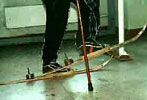
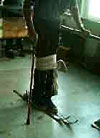
Here I saw for the first time the advise of using skies for physiotherapy exercising.

The walking with skies makes the patient to flex his knees in order to rise a leg higher, but, more important to activate all the ankle movements to avoid the over-crossing of the skies. The exercises may be performed while hording the parallel bars.
The skies are 50-70 cm long and fixated firmly along all the sole to a shoe.
Also weights may be added. I think the weights may be moved along skies or may be located asymmetrically.

Saturday, December 29, 2007

Exercise device


This "Exercise Device" was patented in the USA by Ovid P. Mikell, Jr., from Miami, FL in 1946. The possibility of its usage for rehabilitation was also mentioned in the patent.
A thing like this can be found in almost every sports shop for $10 and more. The use of such device can not be overestimated.